

The Perfect Knee Approach
Preserve Normal Anatomy. Restore Natural Function.
Your knee replacement should respect the muscles and tendons that help you stand, walk, and return to the activities you enjoy. Dr. Austin Nabet combines muscle- and tendon-sparing subvastus surgery with individualized alignment, rapid-recovery planning, and modern opioid-sparing pain management.
The subvastus approach reaches the knee beneath the vastus medialis muscle without splitting that muscle or dividing the quadriceps tendon. The aim is to preserve the structures that power knee extension while replacing the damaged joint surfaces. 1
The Perfect Knee Approach describes Dr. Nabet's philosophy of care, not a guarantee of a perfect result. Your procedure and recovery plan are individualized.
A Different Way to Think About Knee Replacement
Most patients understandably focus on the implant when they think about knee replacement. The implant matters, but it is only part of the story. How the surgeon reaches the joint, handles the surrounding tissues, positions the components, and plans recovery also deserves attention.
My approach begins with a practical question: what healthy tissue can I preserve while performing a safe, well-balanced knee replacement? For most of my primary knee replacements, the subvastus exposure allows me to protect the quadriceps tendon and avoid splitting the vastus medialis muscle. I combine this with a plan tailored to the individual patient rather than treating every knee as though it started with identical anatomy.
That is the thinking behind The Perfect Knee Approach. It is not a different brand of implant or a promise that surgery will recreate an untouched knee. It is a way of bringing the important decisions together: preserve healthy structures where possible, personalize the reconstruction, and support the return of useful function.
Preserve
Protect the quadriceps muscle and tendon when accessing the joint. Tissue preservation matters more than making the skin incision as short as possible.
Personalize
Plan alignment, balance, and fixation around your anatomy, bone quality, and goals. A technique should serve the patient, not the other way around.
Recover
Connect the operation to opioid-sparing pain control, swelling management, safe movement, and clear guidance at home.
See the Difference: Beneath the Muscle, Not Through It
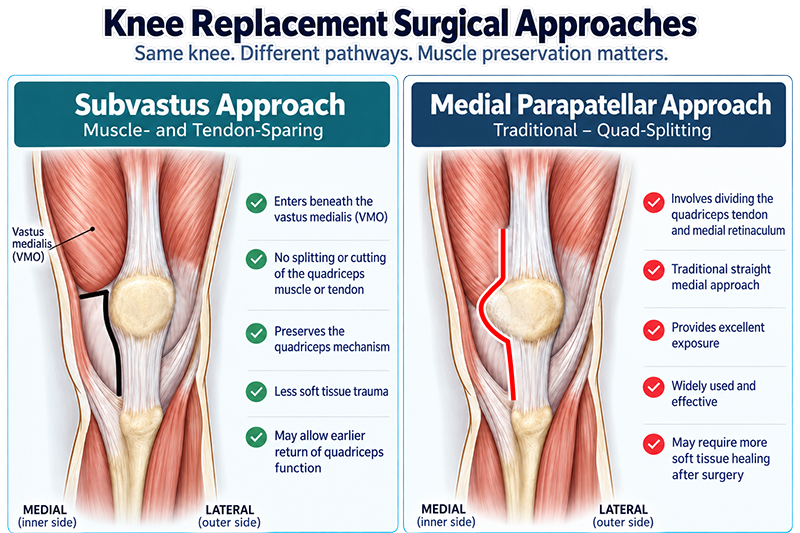
Subvastus: muscle- and tendon-sparing
The surgeon works beneath the vastus medialis, gently mobilizing the muscle rather than splitting it. The quadriceps tendon remains continuous. This is the tissue-preserving distinction shown by the black line, not a claim that no tissue is opened during the operation. 1
Medial parapatellar: an established alternative
The traditional medial parapatellar exposure opens the quadriceps tendon and medial retinacular tissues alongside the kneecap. The tendon and surrounding tissues are repaired at closure. This approach provides reliable exposure and remains an effective option; it does not mean the quadriceps muscle belly is routinely cut in half. 1,3
What Is the Subvastus Approach?
The quadriceps is the large muscle group on the front of your thigh. It connects to the kneecap through the quadriceps tendon and helps straighten the knee. The vastus medialis is the portion on the inner side of the thigh; its lower fibers are often described as the VMO.
Subvastus means beneath the vastus muscle. Instead of splitting that muscle or dividing the quadriceps tendon to reach the joint, the surgeon mobilizes the muscle and approaches from underneath it. The muscle's attachment to the kneecap is preserved. The capsule is still opened so the damaged joint surfaces can be treated. 1
Once inside the joint, the fundamental goals of knee replacement remain the same: prepare the arthritic surfaces, position the implants, achieve appropriate balance, and provide stable fixation. This is a total knee replacement, not an arthroscopic procedure or a replacement of only a small portion of the knee.
A smaller skin incision alone does not tell you what happened underneath. I prefer the term muscle- and tendon-sparing because it explains the structures I am trying to protect, rather than making incision length the measure of a good operation.
Why Preserving the Quadriceps May Matter
Your quadriceps helps you rise from a chair, control the knee while walking, and manage stairs. During the first days after surgery, these are not minor tasks. They are the building blocks of independence.
Swelling and pain can temporarily make the quadriceps harder to activate even when it has not been cut. Preserving the muscle and tendon does not eliminate that response. It does avoid adding a divided quadriceps tendon to the tissues that must heal during early rehabilitation.
Research comparing approaches has reported earlier straight-leg raise, improved early motion, and lower early pain or opioid use in some studies. These are early-recovery findings, not a guarantee of lasting superiority or a prediction of your personal recovery speed. 2,3
- Protect the continuous quadriceps mechanism used for knee extension.
- Support the early return of useful movement while the rest of the knee heals.
- Combine tissue preservation with swelling control and appropriately paced rehabilitation.
What matters to me is translating the surgical plan into practical goals: getting out of bed safely, walking with the right support, and progressing toward your own daily activities. That takes more than choosing an approach.
What Muscle-Sparing Does - and Does Not - Mean
Muscle-sparing does not mean that total knee replacement is minor surgery. Damaged joint surfaces and some underlying bone are removed. Implants are placed, the capsule is opened and repaired, and the body still responds with soreness, swelling, bruising, and fatigue. 4
It also does not mean that every native structure is retained. The phrase Preserve Normal Anatomy describes an intention to respect healthy tissues and individual anatomy where possible. The arthritic surfaces must still be replaced, and other structures may need treatment according to the reconstruction.
Restore Natural Function is the functional goal: a stable, balanced knee that supports daily life. An artificial knee may feel different from a healthy natural knee. It may not have the same motion or permit every activity you performed before arthritis. 4
If a different exposure is needed for a safe operation, I will use it. Protecting your long-term result matters more than forcing a particular incision or maintaining a label.
More Than the Approach: Personalized Knee Replacement
Alignment and ligament balance
Knees differ in shape, alignment, motion, and ligament tension. My planning considers those differences. Kinematic alignment strategies aim to account for the patient's pre-arthritic joint lines rather than assuming one identical alignment target suits every person. The plan still has to produce a stable and appropriately balanced replacement.
Subvastus exposure and kinematic alignment are not the same thing. One describes how I enter the joint; the other helps guide how the reconstructed joint is positioned and balanced. They can work together, but neither automatically guarantees that a knee will feel natural.
Cemented or cementless fixation
The way an implant is fixed is another individual decision. Cementless fixation may be appropriate when bone quality and the implant plan support it; cemented fixation may be the better choice in another patient. A subvastus exposure does not require one fixation method.
Technology that serves the plan
Robotic or computer-assisted tools may help plan or execute aspects of surgery when useful. A robot does not define whether the approach is muscle-sparing, and technology is not a substitute for judgment or careful tissue handling. I consider the approach, alignment, fixation, and available tools as related but separate decisions.
How Muscle-Sparing Fits Into Rapid Recovery
Rapid recovery is a coordinated plan, not a race and not a single device or medication. The work begins before surgery with education, medical optimization, and an understanding of what support you will need at home.
The operation then brings together tissue-sparing exposure, individualized implant planning, and an anesthesia plan appropriate for your health. After surgery, the emphasis shifts to comfortable, safe movement and practical preparation for home.
Many appropriately selected patients can stand and begin walking with assistance on the day of surgery. Some can return home that day. Others benefit from hospital observation. Going home depends on medical stability, mobility, pain control, and home support, not simply the clock or the size of the incision. 4
Your first goals are modest but important: getting up safely, walking with an assistive device, taking medications correctly, and recognizing when to ask for help. A walker is a safety tool, not a sign that the operation has failed.
Muscle-Sparing and Opioid-Sparing Work Together
My pain-management philosophy is to reduce unnecessary opioid exposure without withholding treatment. Muscle-sparing surgery is one part of that plan, but it does not replace a thoughtful medication and recovery program.
Multimodal pain control uses complementary tools: the anesthesia plan, scheduled non-opioid medication when appropriate, anti-inflammatory medication when medically safe, local swelling measures, and rescue medication when needed. Each has a different role. Pain relief and swelling control overlap, but they are not the same process.
Where JOURNAVX fits
JOURNAVX (suzetrigine) is a prescription non-opioid treatment for moderate to severe acute pain in adults. It acts on a peripheral pain-signaling pathway and may be included in your individualized plan. It is a pain medicine, not an anti-inflammatory or a substitute for rehabilitation. 5
JOURNAVX is not suitable for everyone. Medication interactions and other medical considerations must be reviewed; side effects can occur. It should be taken only as prescribed. The medicine alone does not guarantee opioid-free recovery, and research on an overall recovery program should not be presented as proof that one drug caused every benefit.
Some patients still need a limited opioid prescription. That does not mean the surgery or recovery plan failed. The aim is effective pain control with the lowest appropriate opioid exposure, not an expectation that you should tolerate uncontrolled pain.
The First Week: Control Swelling, Protect Function
Swelling can make a knee feel tight and stiff and make the quadriceps harder to use. An active day followed by more soreness does not automatically mean something went wrong, but it may be a signal to reassess the amount of activity with the team.
My early-recovery message is simple: move little and often, then allow time to recover. Follow the plan for short walks, ice with skin protection, elevation, compression when prescribed, and medication. Do not substitute prolonged bed rest for movement, or long walks for properly paced exercise.
Outpatient physical therapy is generally arranged to start approximately one week after surgery. Please schedule it before the operation when possible. Selected patients receive home-health therapy first, commonly three visits in the first two weeks, with transition to outpatient care as directed.
The goal is steady progress in movement and confidence, not winning a competition with another patient's recovery. Your discharge instructions and therapist's guidance take priority over a general website timeline.
Do not assume all swelling is harmless. New or worsening calf pain, unexplained marked swelling, increasing wound drainage, or a sudden change in function warrants prompt contact with the care team. Call 911 for chest pain or difficulty breathing.
Who Is a Candidate?
I use the subvastus approach for most primary knee replacements when appropriate and have performed muscle-sparing knee replacement for many years. Many patients with advanced arthritis, including common bow-legged or knock-kneed patterns, can be considered. The decision is not based on a label or one isolated feature.
During your evaluation, I review your symptoms, examination, imaging, motion, previous surgery, bone quality, and health. I also want to know what your knee is preventing you from doing and what you hope to regain.
Some revision operations, extensive scarring, severe stiffness, unusual anatomy, or complex reconstruction may require a different exposure. The safest approach is selected for the individual patient. Choosing another approach when needed is a safety decision, not a failure of personalized care.
Knee replacement itself should follow a discussion of appropriate nonsurgical care, expected benefit, and risk. A muscle-sparing approach is an option within that decision, not a reason to have an operation before it is right for you.
What Your Treatment Journey Looks Like
Before surgery: prepare the plan and your home
Your surgical planning visit, usually one to two weeks before surgery, is an opportunity to review the operation, required medical optimization and testing, and your tailored medication plan. Bring questions and a current medication list. Arrange transportation, help at home, and the equipment recommended for you.
Have your prescribed medications available before surgery. When JOURNAVX is prescribed through District Pharmacy, respond to its call to coordinate delivery. Other prescriptions go to your preferred local pharmacy. Follow the individualized medication and fasting instructions from our office and your surgical facility rather than general advice online.
Early recovery: build useful movement
Walking and your prescribed home exercises begin as directed; outpatient therapy generally starts around one week. Becoming familiar with the pre-surgery exercise resources ahead of time can make the movements less unfamiliar. Do not automatically resume every preoperative exercise after surgery without the postoperative plan.
The following weeks: progress at your pace
Follow-up commonly occurs around two and six weeks. We assess the incision, motion, strength, walking, and any concerns. Activities are advanced according to your progress, not a fixed promise of returning to work, driving, or sport on a particular date. Improvement can continue beyond the first several weeks.
What the Research Shows
Published studies support a potential early-recovery role for subvastus surgery, but they do not establish a guaranteed best approach for every patient.
A 2023 systematic review and network meta-analysis included 33 randomized trials. It reported early advantages for subvastus or mini-subvastus approaches in measures such as knee motion, pain, and function. Differences diminished over time. A separate, older randomized study found earlier straight-leg raise, better first-week flexion, and lower early opioid consumption with the subvastus approach. 2,3
The practical interpretation is measured: protecting the quadriceps may help during the demanding early phase of recovery. It does not prove a permanently superior knee, eliminate surgical risks, or predict exactly when an individual will reach a milestone.
These studies examine surgical approaches. They are not trials of the name The Perfect Knee Approach or of every element in my combined care program. Long-term success still depends on the quality of the reconstruction, your health, rehabilitation, and other individual factors.
See Recovery in Real Life
My patient recovery videos show examples of people working toward their own goals after muscle- and tendon-sparing knee replacement. They can help you understand what progress may look like and give you questions to bring to your consultation.
An individual video is not a forecast for your recovery. Patients differ in strength, motion, health, surgical complexity, and support at home. A strong early result should be encouraging without becoming a deadline you feel pressured to meet.
Frequently Asked Questions
What is The Perfect Knee Approach?
It is Dr. Nabet's name for a philosophy that brings together muscle preservation, individualized knee reconstruction, and recovery-focused care. It is not a separate implant or a promise of a flawless result. The specific surgical plan is tailored to each patient.
Does subvastus knee replacement cut the quadriceps tendon?
In a subvastus exposure, the quadriceps tendon is preserved and the vastus medialis muscle is not split. Access is gained beneath the muscle. Skin, capsule, and other tissues still require surgical treatment, and the damaged joint surfaces are replaced. 1
Is this the same as a small-incision knee replacement?
Not necessarily. Skin-incision length and the deeper surgical pathway are different things. Muscle- and tendon-sparing describes the intended preservation of the quadriceps mechanism. The incision must be large enough to perform the replacement safely and accurately.
Is subvastus the same as midvastus?
No. They are different exposures. A midvastus approach splits part of the vastus medialis; a subvastus approach passes beneath it. Ask which structures are preserved rather than relying only on the broad phrase minimally invasive.
Will my knee feel exactly like it did before arthritis?
That cannot be promised. The goal is less arthritis-related pain and improved function, with a stable, balanced replacement. An artificial knee can still feel different, and some activities or positions may remain uncomfortable. Restore Natural Function expresses a goal, not a guarantee. 4
Will I recover faster?
Some studies report advantages in early recovery measures with subvastus approaches, but individual results vary and differences can diminish over time. Your starting strength, motion, health, surgical complexity, swelling, and rehabilitation also matter. There is no guaranteed faster-recovery date. 2,3
Will I still need physical therapy?
Yes, the postoperative movement and rehabilitation plan remains important. Outpatient therapy is generally scheduled for about one week after surgery; some patients start with home-health visits. The therapist and surgical team tailor progression to your needs.
Can a bow-legged or knock-kneed knee be treated this way?
Many such knees can be considered, but the degree of deformity, stiffness, scarring, and other findings affect the plan. Your examination and imaging help determine the safest exposure and reconstruction rather than the description alone.
Can this be combined with kinematic alignment?
Yes. The exposure and alignment plan address different parts of the operation. The subvastus approach describes how the joint is reached. Kinematic alignment considers individual joint lines and anatomy when planning reconstruction, within the requirements of balance and stability.
Does muscle-sparing surgery require a robot?
No. Muscle preservation is determined by the surgical exposure and tissue handling, not by the presence of a robot. Robotic or computer-assisted tools may be used when useful for the individual plan, but they do not define the subvastus approach.
Can I have cementless fixation?
Potentially. Bone quality, anatomy, and the implant plan determine whether cementless or cemented fixation is appropriate. Both the fixation decision and the approach are individualized; one does not automatically dictate the other.
Does opioid-sparing mean I cannot receive an opioid?
No. The aim is to reduce unnecessary opioid exposure while treating pain effectively. Non-opioid measures form an important part of the plan, and rescue medication remains available when clinically appropriate. Follow your personalized prescriptions and discharge instructions.
Is JOURNAVX required for this approach?
No. It is one possible non-opioid medication within a broader pain plan. Medical suitability, interactions, access, and individual needs are reviewed before prescribing. The surgical approach and recovery program do not depend on one medication alone. 5
Will I go home on the day of surgery?
Some appropriately selected patients do. Discharge depends on medical stability, safe mobility, pain control, home support, and the facility plan. Needing observation or an overnight stay does not mean you are behind in recovery.
Why does the first week focus on swelling?
Swelling can make the knee stiff and the quadriceps harder to activate. The plan balances short, frequent movement with recovery time, ice, elevation, and other prescribed measures. More activity is not always better; sudden or concerning changes still need medical assessment.
Are there still risks?
Yes. Total knee replacement can involve infection, blood clots, bleeding, stiffness, persistent pain, nerve or vessel injury, implant problems, and further surgery. A muscle-sparing approach does not remove those risks. We discuss the benefits, alternatives, and risks that apply to you. 4
A Modern Knee Replacement Should Respect the Whole Knee
The operation should consider more than the implant. It should account for how the joint is reached, how healthy tissues are respected, how the reconstruction is personalized, and how recovery is supported after you leave the surgical facility.
That is what I want The Perfect Knee Approach to communicate: a commitment to preserve what can be preserved, restore useful function, and treat the person rather than only the X-ray.
If knee arthritis is limiting your life, schedule a consultation to discuss whether muscle-sparing subvastus knee replacement is appropriate for you. Together, we will review your options and build a plan around your anatomy, health, and goals.
Austin C. Nabet, DO, FAAOS | Atlantic Orthopaedic Specialists | Serving Norfolk, Virginia Beach, and Hampton Roads.
Looking for muscle-sparing hip replacement? Explore direct anterior hip replacement.
Selected medical references
- Endres NK, Minas T. Medial Subvastus Approach to the Knee: Surgical Technique. Orthopaedic Journal at Harvard Medical School. Vol. 10, pp. 62-65.
- Stubnya BG, et al. Subvastus Approach Supporting Fast-Track Total Knee Arthroplasty Over the Medial Parapatellar Approach: A Systematic Review and Network Meta-Analysis. J Arthroplasty. 2023;38(12):2750-2758. doi:10.1016/j.arth.2023.06.004.
- Roysam GS, Oakley MJ. Subvastus approach for total knee arthroplasty: a prospective, randomized, and observer-blinded trial. J Arthroplasty. 2001;16(4):454-457. doi:10.1054/arth.2001.22388.
- American Academy of Orthopaedic Surgeons. Total Knee Replacement. OrthoInfo.
- U.S. Food and Drug Administration. FDA Approves Novel Non-Opioid Treatment for Moderate to Severe Acute Pain. January 30, 2025.
This page provides general education and does not replace individualized medical advice, informed consent, or your written postoperative instructions. Surgical approach, implant selection, alignment, medications, and recovery plans vary by patient. No surgical outcome is guaranteed.


